Shai Hong vs Pu-erh: Same Yunnan Landscape, Different Leaf Decisions

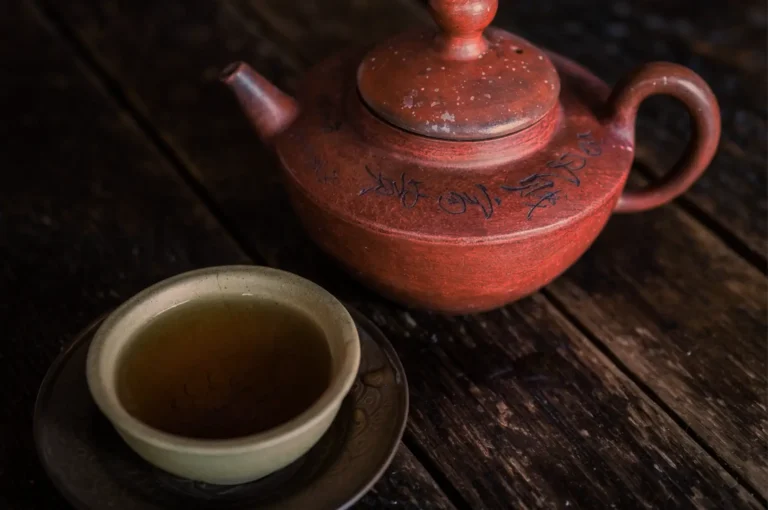
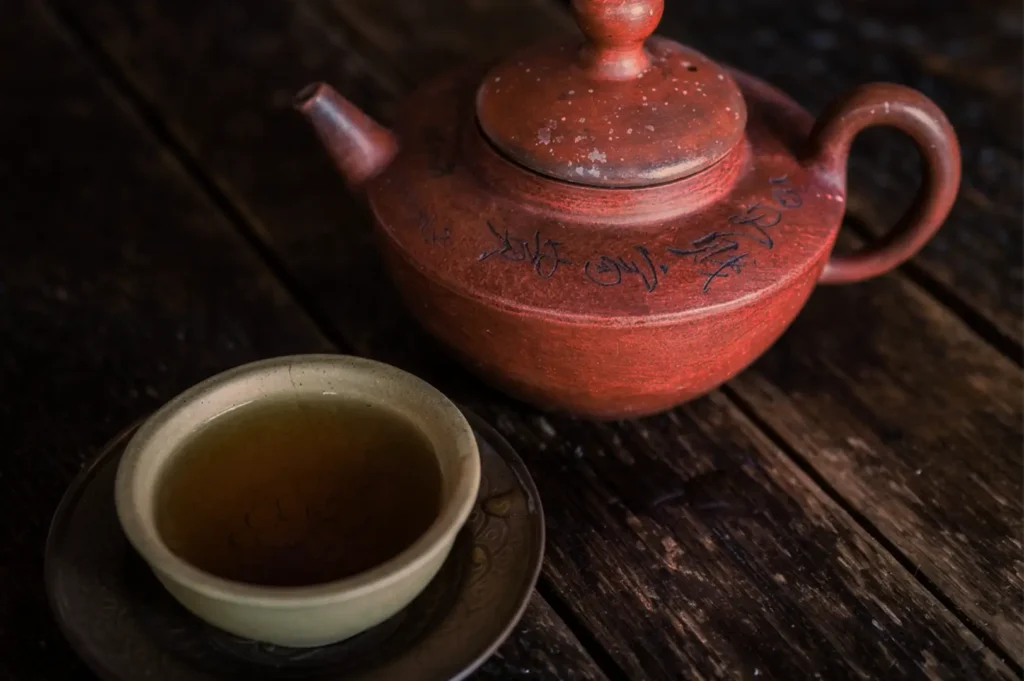
A close-up high-angle shot with a shallow depth of field focusing on a weathered, speckled terracotta-red Yixing clay teapot engraved with cursive Chinese calligraphy along its shoulder, positioned behind a rustic pale-celadon ceramic teacup resting on a dark metal coaster and filled with amber-gold brewed tea, set on dark, weathered wooden planks with visible grain and small water droplets under soft, directional natural lighting.

Yunnan produces some of China’s most distinctive teas.

Two may come from nearby tea-growing landscapes and still belong to different traditions.

Shai Hong and Pu-erh are useful examples.

Both are connected to Yunnan. Both can be made from large-leaf tea material. Both may attract drinkers interested in older trees, regional provenance and the effects of processing.

But they do not become the same tea simply by sharing a mountain.

Shai Hong and Pu-erh are separated by what happens to the leaves after harvest.

For the larger Shai Hong picture, see our guide to Yunnan’s sun-finished red tea.

Shai Hong Follows Black-Tea Processing
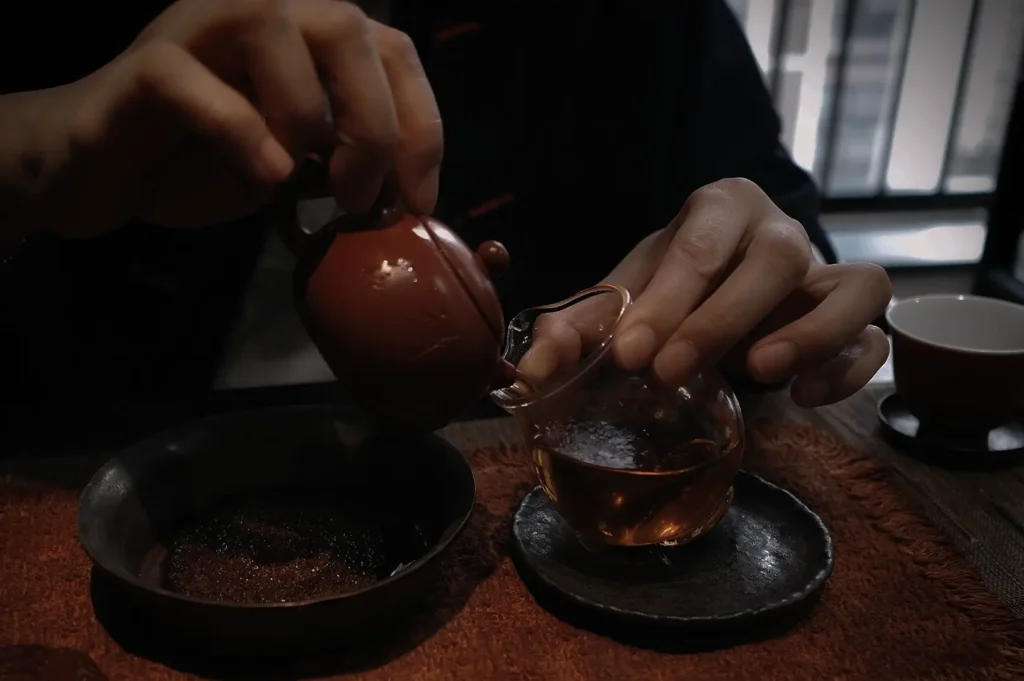
A close-up eye-level shot with a shallow depth of field focusing on a tea practitioner's hands—wearing a dark traditional jacket with subtle red frog closures—using their right hand to tilt a small, glossy reddish-brown Yixing clay teapot while steadying a clear glass fairness pitcher (gong dao bei) resting on a dark textured saucer with their left fingers to decant amber-gold brewed tea, positioned beside a shallow dark metal waste bowl (jian shui) on a rust-brown woven cloth mat, with a small white-rimmed red ceramic teacup on a dark coaster to the right and a softly blurred window with vertical mullions in the dimly lit background.

Shai Hong is a form of oxidised black tea.

The leaves are withered, rolled, allowed to undergo enzymatic oxidation and then dried using sunlight.

This oxidation is central to its identity.

The final solar drying stage is important, but it does not change the category into Pu-erh.

Raw Pu-erh Takes Another Route
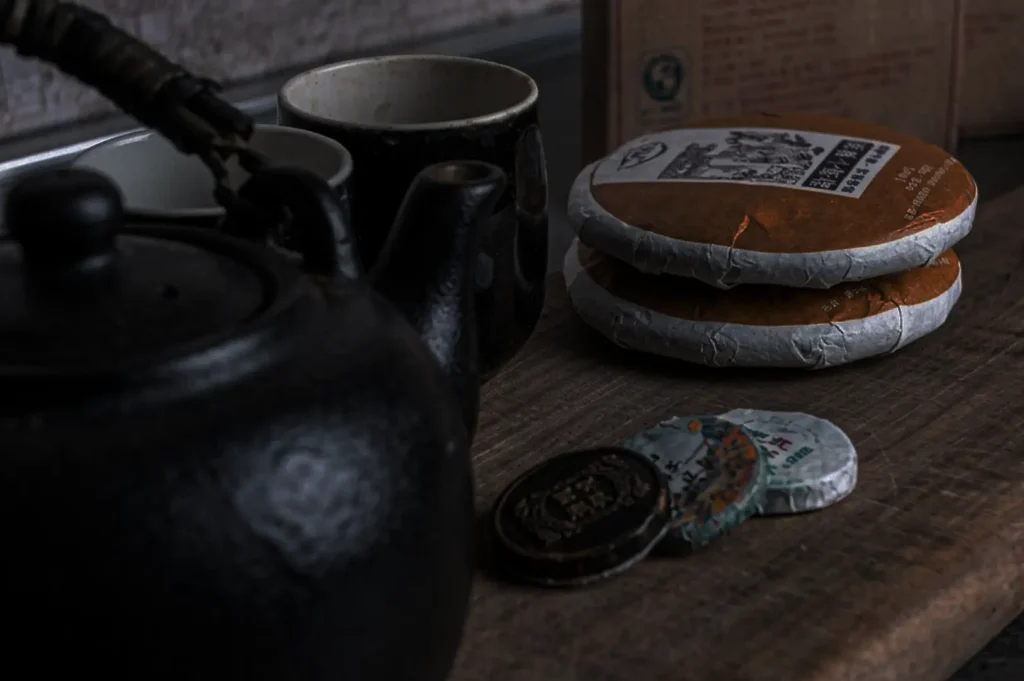
A close-up eye-level shot with a shallow depth of field focusing on two stacked round pu-erh tea cakes (bing cha) wrapped in orange-brown and white cotton paper with traditional black-and-white printed Chinese labels resting on a weathered dark wooden board in the upper right, accompanied in the foreground by three small coin-sized mini tea cakes—one unwrapped dark compressed tea disc stamped with raised Chinese characters in the center and two wrapped in colorful patterned paper—positioned beside a textured black cast-iron teapot (tetsubin) with a woven-wrapped overhead handle and two rustic dark glazed ceramic tumblers with pale interiors on the left, with cardboard tea packaging boxes softly visible in the dimly lit background.

Raw Pu-erh, often called sheng, generally begins with leaf fixation, rolling and drying to produce sun-dried green tea material.

That initial heating stage changes the course of enzymatic reactions.

A 2026 study examining five types of Yunnan large-leaf tea compared their processing routes and chemical compositions, demonstrating how different manufacturing decisions produce markedly different results from related material.

The same leaf origin cannot erase the difference between oxidation and fixation.

Ripe Pu-erh Adds Microbial Fermentation
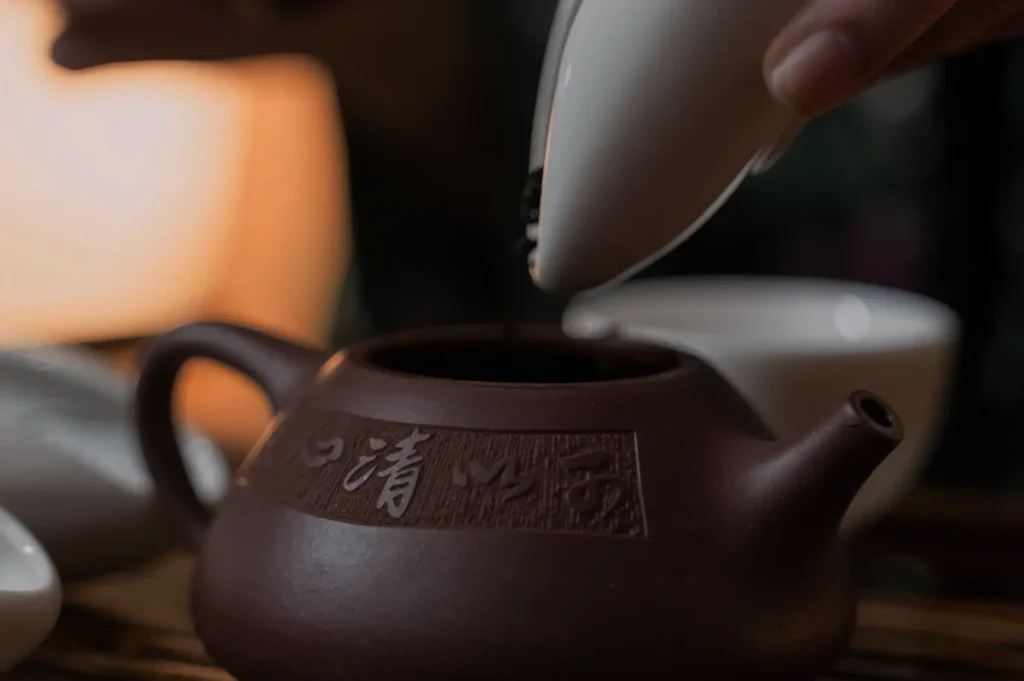
A close-up eye-level shot with a shallow depth of field focusing on a hand tilting a glossy white porcelain tea scoop (cha he) to pour dark loose-leaf tea into the open top of a matte dark-brown Yixing clay teapot engraved along its shoulder with a textured rectangular panel of Chinese calligraphy reading "可以清心" (ke yi qing xin, "clears the mind"), set against a softly blurred white ceramic teacup on the right and a warm, glowing amber light in the dark background.

Ripe Pu-erh, or shou, undergoes a deliberate microbial pile-fermentation process.

This is different from the enzymatic oxidation used to create black tea.

The distinction helps explain why ripe Pu-erh commonly has a deeper, earthier profile, while Shai Hong belongs to the black-tea family.

UNESCO recognises black and dark tea as distinct traditional Chinese tea categories.

Does Shai Hong Age Like Pu-erh?
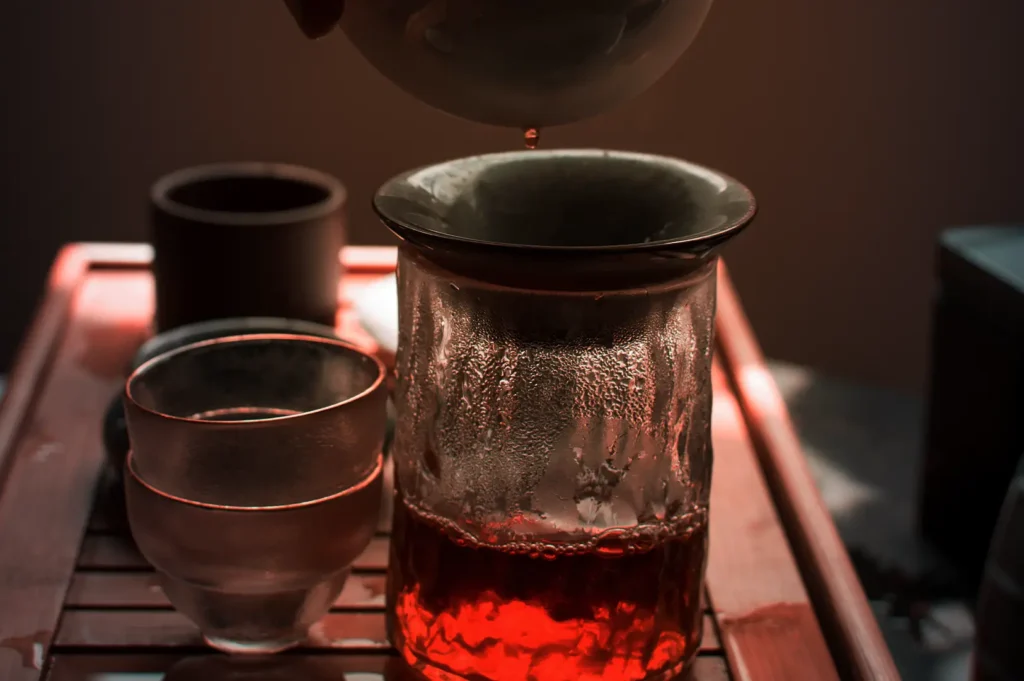
A close-up eye-level shot with a shallow depth of field focusing on a single amber droplet of tea falling from a tilted brewing vessel held above a textured, condensation-beaded glass fairness pitcher (gong dao bei) fitted with a flared dark ceramic strainer and filled halfway with glowing ruby-red brewed tea on a slatted reddish-brown wooden tea tray (cha pan), flanked on the left by two stacked frosted glass tasting cups and a cylindrical dark clay utensil holder, with the dark corner of a tea caddy visible on the far right under dramatic, warm directional lighting.

It should not be assumed.

Ageing is part of the established appreciation of many Pu-erh teas, but Shai Hong’s long-term storage characteristics require their own evaluation.

Research into raw Pu-erh ageing over multiple decades examines a specific tea tradition under defined storage conditions.

Those findings cannot simply be transferred to sun-dried black tea.

Shai Hong may change with time. Whether the change is desirable depends on the individual tea and its storage.

Which Tea Should You Choose?
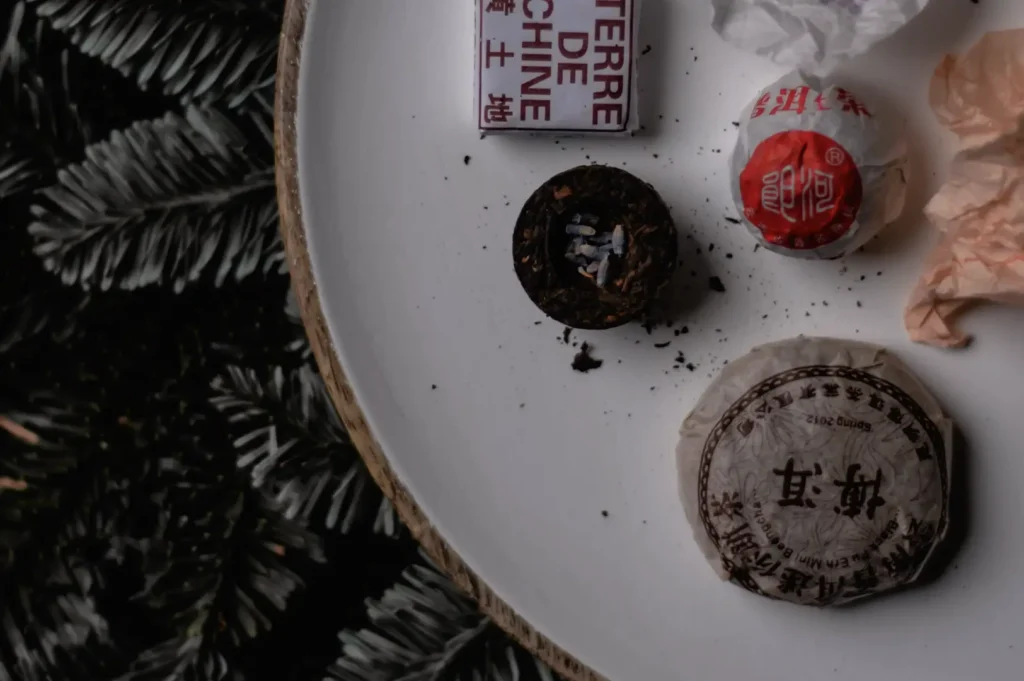
A flat-lay top-down shot of an assortment of compressed pu-erh tea portions arranged on a round matte-white ceramic plate with a textured wood-like rim resting over dark, frosted evergreen pine needles on the left, featuring an unwrapped dark-brown bowl-shaped mini tuo cha nest filled with dried purple lavender buds in the center surrounded by scattered tea crumbs, a rectangular white-and-red paper-wrapped tea block printed with "TERRE DE CHINE" and Chinese characters above it, a twisted white-and-red foil-wrapped spherical dragon pearl tea ball to the upper right, crumpled peach-toned tissue wrapper on the far right, and a larger round mini pu-erh tea cake wrapped in off-white cotton paper printed with Chinese calligraphy and "Black Pu Erh Mini Beengcha" in the lower right under soft, diffused natural lighting.

Choose Shai Hong if you want to explore Yunnan through an oxidised black-tea expression.

Choose raw Pu-erh if you are interested in the development of a different tea-processing tradition through storage.

Choose ripe Pu-erh if you prefer a deeper, microbial-fermentation-led profile.

At Tea Room by Ki-setsu, both Shai Hong and Pu-erh are meaningful parts of our wider tea appreciation. Their differences create a useful conversation about what processing contributes to quality.

Final Thought
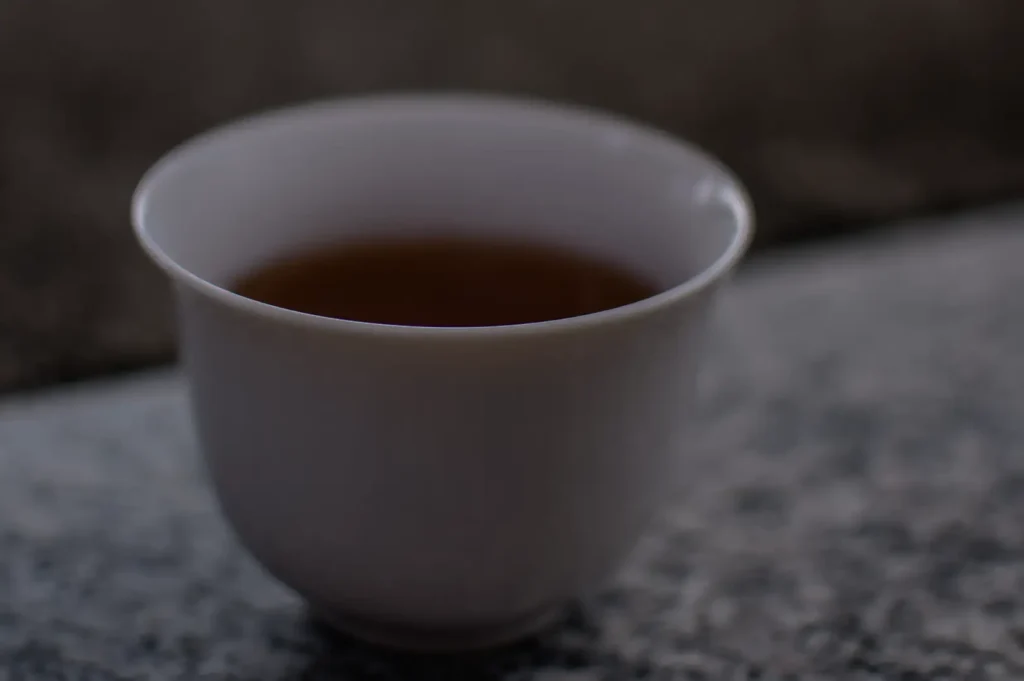
A close-up eye-level shot with a very shallow depth of field focusing on the delicate flared rim of a small, smooth white porcelain tasting teacup filled halfway with dark amber-brown brewed tea, resting on a mottled gray-and-black speckled granite stone surface set against a softly blurred dark brown background under soft, diffused low-key natural lighting.

Shai Hong vs Pu-erh is not a question of which Yunnan tea is more authentic.

Both belong to the region’s tea culture.

But they follow different paths.

Origin tells us where the story begins. Processing tells us which story the leaf becomes.